
Monday, February 10, 2020
Due Tuesday, February 11th - Read "The Stranger" by Albert Camus, Chapters 1-3
Overview and Directions: Read The Stranger by Albert Camus, Chapters 1-3. Please apply the ideas of Existentialism to your reading of the text. Pair direct quotations from the novel with Sartre's essay on Existentialism. I look forward to your responses.

Monday, February 3, 2020
Due Monday, February 10th - Finish reading "Marjorie Prime" by Jordan Harrison & Reflection

2) In class, I asked you to compose a journal response, in which you spoke openly with a loved one you find it hard to speak to. You imagined this person as a Prime, let your inhibitions down, and speak to this person the way you have always wanted to. Using that piece of writing as a springboard, compose a polished piece to be read to your loved one as a Prime. Sign it and place it in an envelope. Bring it to class so I can see your work and give you credit for the assignment. My hope? Someday, you will build the courage to speak to this person and share your feelings like these characters did with their Prime. If the loved one you chose is deceased, perhaps you read it aloud, as if they may hear you and give yourself closure. I will be doing this assignment with you. I look forward to this journey together. (NOTE: You will in no way be asked to share this work with me or anyone in class, unless you choose to. This is for you).
Wednesday, January 29, 2020
Due Monday, February 3rd - "Marjorie Prime" (Part I) by Jordan Harrison

Overview: Jordan Harrison's Marjorie Prime explores our relationships with family, much like Henrik Ibsen did in his time with A Doll House. However, Harrison also delves into the ways in which memory shapes our choices and future. By doing so, he attends to the new challenges we face in our psychologically conscious world.
Directions: Read Marjorie Prime, Part I (pages 1-33 in the document). Next, compose a comprehensive blog response (300 words) attending to the following questions, using direct evidence from the text: By using the conceit of a Prime, how do the characters reinvent their loved ones into what and who they want them to be? How do the Primes and the living, in turn, reinvent themselves? How are we all like Marjorie, when it come to memory retrieval? How do the ideas of Existentialism apply to these ideas and this play? Are there any questions or concepts you found interesting or confusing that you would like to explore in class?
Tuesday, January 28, 2020
Due Wednesday, January 29th - The Artist in Existential Crisis

Overview: I would like you to apply the concept of Existentialism to the following short story by Franz Kafka, "The Hunger Artist." The piece utilizes the stages of Existentialism to show what it takes to be a true artist. I would like you to read the text with that critical lens in mind.
Directions: Please read "A Hunger Artist" by Franz Kafka. Again, apply the three stages of existentialism to the text. Comment in this blog space using direct evidence from The Hunger Artist AND Jean-Paul Sartre's piece on Existentialism.
"A Hunger Artist" by Franz Kafka
In the last decades interest in hunger artists has declined considerably. Whereas in earlier days there was good money to be earned putting on major productions of this sort under one’s own management, nowadays that is totally impossible. Those were different times. Back then the hunger artist captured the attention of the entire city. From day to day while the fasting lasted, participation increased. Everyone wanted to see the hunger artist at least once a day. During the later days there were people with subscription tickets who sat all day in front of the small barred cage. And there were even viewing hours at night, their impact heightened by torchlight. On fine days the cage was dragged out into the open air, and then the hunger artist was put on display particularly for the children. While for grown-ups the hunger artist was often merely a joke, something they participated in because it was fashionable, the children looked on amazed, their mouths open, holding each other’s hands for safety, as he sat there on scattered straw—spurning a chair—in black tights, looking pale, with his ribs sticking out prominently, sometimes nodding politely, answering questions with a forced smile, even sticking his arm out through the bars to let people feel how emaciated he was, but then completely sinking back into himself, so that he paid no attention to anything, not even to what was so important to him, the striking of the clock, which was the single furnishing in the cage, but merely looking out in front of him with his eyes almost shut and now and then sipping from a tiny glass of water to moisten his lips.
Apart from the changing groups of spectators there were also constant observers chosen by the public—strangely enough they were usually butchers—who, always three at a time, were given the task of observing the hunger artist day and night, so that he didn’t get anything to eat in some secret manner. It was, however, merely a formality, introduced to reassure the masses, for those who understood knew well enough that during the period of fasting the hunger artist would never, under any circumstances, have eaten the slightest thing, not even if compelled by force. The honor of his art forbade it. Naturally, none of the watchers understood that. Sometimes there were nightly groups of watchers who carried out their vigil very laxly, deliberately sitting together in a distant corner and putting all their attention into playing cards there, clearly intending to allow the hunger artist a small refreshment, which, according to their way of thinking, he could get from some secret supplies. Nothing was more excruciating to the hunger artist than such watchers. They depressed him. They made his fasting terribly difficult. Sometimes he overcame his weakness and sang during the time they were observing, for as long as he could keep it up, to show people how unjust their suspicions about him were. But that was little help. For then they just wondered among themselves about his skill at being able to eat even while singing. He much preferred the observers who sat down right against the bars and, not satisfied with the dim backlighting of the room, illuminated him with electric flashlights, which the impresario made available to them. The glaring light didn’t bother him in the slightest. Generally he couldn’t sleep at all, and he could always doze off a little under any lighting and at any hour, even in an overcrowded, noisy auditorium. With such observers, he was very happily prepared to spend the entire night without sleeping. He was ready to joke with them, to recount stories from his nomadic life and then, in turn, to listen to their stories—doing everything just to keep them awake, so that he could keep showing them once again that he had nothing to eat in his cage and that he was fasting as none of them could. He was happiest, however, when morning came and a lavish breakfast was brought for them at his own expense, on which they hurled themselves with the appetite of healthy men after a hard night’s work without sleep. True, there were still people who wanted to see in this breakfast an unfair means of influencing the observers, but that was going too far, and if they were asked whether they wanted to undertake the observers’ night shift for its own sake, without the breakfast, they excused themselves. But nonetheless they stood by their suspicions.
However, it was, in general, part of fasting that these doubts were inextricably associated with it. For, in fact, no one was in a position to spend time watching the hunger artist every day and night without interruption, so no one could know, on the basis of his own observation, whether this was a case of truly continuous, flawless fasting. The hunger artist himself was the only one who could know that and, at the same time, the only spectator capable of being completely satisfied with his own fasting. But the reason he was never satisfied was something different. Perhaps it was not fasting at all which made him so very emaciated that many people, to their own regret, had to stay away from his performance, because they couldn’t bear to look at him. For he was also so skeletal out of dissatisfaction with himself, because he alone knew something that even initiates didn’t know—how easy it was to fast. It was the easiest thing in the world. About this he did not remain silent, but people did not believe him. At best they thought he was being modest. Most of them, however, believed he was a publicity seeker or a total swindler, for whom, at all events, fasting was easy, because he understood how to make it easy, and then still had the nerve to half admit it. He had to accept all that. Over the years he had become accustomed to it. But this dissatisfaction kept gnawing at his insides all the time and never yet—and this one had to say to his credit—had he left the cage of his own free will after any period of fasting. The impresario had set the maximum length of time for the fast at forty days—he would never allow the fasting go on beyond that point, not even in the cosmopolitan cities. And, in fact, he had a good reason. Experience had shown that for about forty days one could increasingly whip up a city’s interest by gradually increasing advertising, but that then the public turned away—one could demonstrate a significant decline in popularity. In this respect, there were, of course, small differences among different towns and among different countries, but as a rule it was true that forty days was the maximum length of time. So then on the fortieth day the door of the cage—which was covered with flowers—was opened, an enthusiastic audience filled the amphitheater, a military band played, two doctors entered the cage in order to take the necessary measurements of the hunger artist, the results were announced to the auditorium through a megaphone, and finally two young ladies arrived, happy to have just been selected by lot, and sought to lead the hunger artist down a couple of steps out of the cage, where on a small table a carefully chosen hospital meal was laid out. And at this moment the hunger artist always fought back. Of course, he still freely laid his bony arms in the helpful outstretched hands of the ladies bending over him, but he did not want to stand up. Why stop right now after forty days? He could have kept going for even longer, for an unlimited length of time. Why stop right now, when he was in his best form, indeed, not yet even in his best fasting form? Why did people want to rob him of the fame of fasting longer, not just so that he could become the greatest hunger artist of all time, which, in fact, he probably was already, but also so that he could surpass himself in some unimaginable way, for he felt there were no limits to his capacity for fasting. Why did this crowd, which pretended to admire him so much, have so little patience with him? If he kept going and kept fasting even longer, why would they not tolerate it? Then, too, he was tired and felt good sitting in the straw. Now he was supposed to stand up straight and tall and go to eat, something which, when he merely imagined it, made him feel nauseous right away. With great difficulty he repressed mentioning this only out of consideration for the women. And he looked up into the eyes of these women, apparently so friendly but in reality so cruel, and shook his excessively heavy head on his feeble neck. But then happened what always happened. The impresario came forward without a word—the music made talking impossible—raised his arms over the hunger artist, as if inviting heaven to look upon its work here on the straw, this unfortunate martyr (something the hunger artist certainly was, only in a completely different sense), grabbed the hunger artist around his thin waist, in the process wanting with his exaggerated caution to make people believe that here he had to deal with something fragile, and handed him over—not without secretly shaking him a little, so that the hunger artist’s legs and upper body swung back and forth uncontrollably—to the women, who had in the meantime turned as pale as death. At this point, the hunger artist endured everything. His head lay on his chest—it was as if it had inexplicably rolled around and just stopped there—his body was arched back, his legs, in an impulse of self-preservation, pressed themselves together at the knees, but scraped the ground, as if they were not really on the floor but were looking for the real ground, and the entire weight of his body, admittedly very small, lay against one of the women, who appealed for help with flustered breath, for she had not imagined her post of honor would be like this, and then stretched her neck as far as possible, to keep her face from the least contact with the hunger artist, but then, when she couldn’t manage this and her more fortunate companion didn’t come to her assistance but trembled and remained content to hold in front of her the hunger artist’s hand, that small bundle of knuckles, she broke into tears, to the delighted laughter of the auditorium, and had to be relieved by an attendant who had been standing ready for some time. Then came the meal. The impresario put a little food into the mouth of the hunger artist, now dozing as if he were fainting, and kept up a cheerful patter designed to divert attention away from the hunger artist’s condition. Then a toast was proposed to the public, which was supposedly whispered to the impresario by the hunger artist, the orchestra confirmed everything with a great fanfare, people dispersed, and no one had the right to be dissatisfied with the event, no one except the hunger artist—he was always the only one.
He lived this way, taking small regular breaks, for many years, apparently in the spotlight, honored by the world, but for all that, his mood was usually gloomy, and it kept growing gloomier all the time, because no one understood how to take it seriously. But how was he to find consolation? What was there left for him to wish for? And if a good-natured man who felt sorry for him ever wanted to explain to him that his sadness probably came from his fasting, then it could happen, especially at an advanced stage of the fasting, that the hunger artist responded with an outburst of rage and began to shake the cage like an animal, frightening everyone. But the impresario had a way of punishing moments like this, something he was happy to use. He would make an apology for the hunger artist to the assembled public, conceding that the irritability had been provoked only by his fasting, which well-fed people did not readily understand and which was capable of excusing the behavior of the hunger artist. From there he would move on to speak about the equally hard-to-understand claim of the hunger artist that he could go on fasting for much longer than he was doing. He would praise the lofty striving, the good will, and the great self-denial no doubt contained in this claim, but then would try to contradict it simply by producing photographs, which were also on sale, for in the pictures one could see the hunger artist on the fortieth day of his fast, in bed, almost dead from exhaustion. Although the hunger artist was very familiar with this perversion of the truth, it strained his nerves every time and was too much for him. What was a result of the premature ending of the fast people were now proposing as its cause! It was impossible to fight against this lack of understanding, against this world of misunderstanding. In good faith he still always listened eagerly to the impresario at the bars of his cage, but each time, once the photographs came out, he would let go of the bars and, with a sigh, sink back into the straw, and a reassured public could come up again and view him.
When those who had witnessed such scenes thought back on them a few years later, often they were unable to understand themselves. For in the meantime that change mentioned above had set in. It happened almost immediately. There may have been more profound reasons for it, but who bothered to discover what they were? At any rate, one day the pampered hunger artist saw himself abandoned by the crowd of pleasure seekers, who preferred to stream to other attractions. The impresario chased around half of Europe one more time with him, to see whether he could rediscover the old interest here and there. It was all futile. It was as if a secret agreement against the fasting performances had really developed everywhere. Naturally, the truth is that it could not have happened so quickly, and people later remembered some things which in the days of intoxicating success they had not paid sufficient attention to, some inadequately suppressed indications, but now it was too late to do anything to counter them. Of course, it was certain that the popularity of fasting would return once more someday, but for those now alive that was no consolation. What was the hunger artist to do now? The man whom thousands of people had cheered on could not display himself in show booths at small fun fairs, and the hunger artist was not only too old to take up a different profession, but was fanatically devoted to fasting more than anything else. So he said farewell to the impresario, an incomparable companion on his life’s road, and let himself be hired by a large circus. In order to spare his own sensitive feelings, he didn’t even look at the terms of his contract.
A large circus with its huge number of men, animals, and gimmicks, which are constantly being let go and replenished, can use anyone at any time, even a hunger artist, provided, of course, his demands are modest. Moreover, in this particular case it was not only the hunger artist himself who was engaged, but also his old and famous name. In fact, given the characteristic nature of his art, which was not diminished by his advancing age, one could never claim that a worn-out artist, who no longer stood at the pinnacle of his ability, wanted to escape to a quiet position in the circus. On the contrary, the hunger artist declared that he could fast just as well as in earlier times—a claim that was entirely credible. Indeed, he even affirmed that if people would let him do what he wanted—and he was promised this without further ado—he would really now legitimately amaze the world for the first time, an assertion which, however, given the mood of the time, something the hunger artist in his enthusiasm easily overlooked, only brought smiles from the experts.
In essence, however, the hunger artist had also not forgotten his sense of the way things really were, and he took it as self-evident that people would not set him and his cage up as some star attraction in the middle of the arena, but would move him outside in some other readily accessible spot near the animal stalls. Huge brightly painted signs surrounded the cage and announced what there was to look at there. During the intervals in the main performance, when the general public pushed out towards the menagerie in order to see the animals, they could hardly avoid moving past the hunger artist and stopping there a moment. They would perhaps have remained with him longer, if those pushing up behind them in the narrow passageway, who did not understand this pause on the way to the animal stalls they wanted to see, had not made a longer peaceful observation impossible. This was also the reason why the hunger artist began to tremble before these visiting hours, which he naturally used to long for as the main purpose of his life. In the early days he could hardly wait for the pauses in the performances. He had looked forward with delight to the crowd pouring around him, until he became convinced only too quickly—and even the most stubborn, almost deliberate self-deception could not hold out against the experience—that, judging by their intentions, most of these people were, time and again without exception, only visiting the menagerie. And this view from a distance still remained his most beautiful moment. For when they had come right up to him, he immediately got an earful from the shouting and cursing of the two steadily increasing groups, the ones who wanted to take their time looking at the hunger artist, not with any understanding but on a whim or from mere defiance—for him these ones were soon the more painful—and a second group of people whose only demand was to go straight to the animal stalls. Once the large crowds had passed, the late-comers would arrive, and although there was no longer anything preventing these people from sticking around for as long as they wanted, they rushed past with long strides, almost without a sideways glance, to get to the animals in time. And it was an all-too-rare stroke of luck when the father of a family came by with his children, pointed his finger at the hunger artist, gave a detailed explanation about what was going on here, and talked of earlier years, when he had been present at similar but incomparably more magnificent performances, and then the children, because they had been inadequately prepared at school and in life, always stood around still uncomprehendingly. What was fasting to them? But nonetheless the brightness of the look in their searching eyes revealed something of new and more gracious times coming. Perhaps, the hunger artist said to himself sometimes, everything would be a little better if his location were not quite so near the animal stalls. That way it would be easy for people to make their choice, to say nothing of the fact that he was very upset and constantly depressed by the stink from the stalls, the animals’ commotion at night, the pieces of raw meat dragged past him for the carnivorous beasts, and the roars at feeding time. But he did not dare to approach the administration about it. In any case, he had the animals to thank for the crowds of visitors among whom, now and then, there could also be one destined for him. And who knew where they would hide him if he wished to remind them of his existence and, along with that, of the fact that, strictly speaking, he was only an obstacle on the way to the menagerie.
A small obstacle, at any rate, a constantly diminishing obstacle. People became accustomed to thinking it strange that in these times they would want to pay attention to a hunger artist, and with this habitual awareness the judgment on him was pronounced. He might fast as well as he could—and he did—but nothing could save him anymore. People went straight past him. Try to explain the art of fasting to anyone! If someone doesn’t feel it, then he cannot be made to understand it. The beautiful signs became dirty and illegible. People tore them down, and no one thought of replacing them. The small table with the number of days the fasting had lasted, which early on had been carefully renewed every day, remained unchanged for a long time, for after the first weeks the staff grew tired of even this small task. And so the hunger artist kept fasting on and on, as he once had dreamed about in earlier times, and he had no difficulty at all managing to achieve what he had predicted back then, but no one was counting the days—no one, not even the hunger artist himself, knew how great his achievement was by this point, and his heart grew heavy. And when once in a while a person strolling past stood there making fun of the old number and talking of a swindle, that was in a sense the stupidest lie which indifference and innate maliciousness could invent, for the hunger artist was not being deceptive—he was working honestly—but the world was cheating him of his reward.
Many days went by once more, and this, too, came to an end. Finally the cage caught the attention of a supervisor, and he asked the attendant why they had left this perfectly useful cage standing here unused with rotting straw inside. Nobody knew, until one man, with the help of the table with the number on it, remembered the hunger artist. They pushed the straw around with poles and found the hunger artist in there. “Are you still fasting?” the supervisor asked. “When are you finally going to stop?” “Forgive me everything,” whispered the hunger artist. Only the supervisor, who was pressing his ear up against the cage, understood him. “Certainly,” said the supervisor, tapping his forehead with his finger in order to indicate to the staff the state the hunger artist was in, “we forgive you.” “I always wanted you to admire my fasting,” said the hunger artist. “But we do admire it,” said the supervisor obligingly. “But you shouldn’t admire it,” said the hunger artist. “Well then, we don’t admire it,” said the supervisor, “but why shouldn’t we admire it?” “Because I have to fast. I can’t do anything else,” said the hunger artist. “Just look at you,” said the supervisor, “why can’t you do anything else?” “Because,” said the hunger artist, lifting his head a little and, with his lips pursed as if for a kiss, speaking right into the supervisor’s ear so that he wouldn’t miss anything, “because I couldn’t find a food that tasted good to me. If had found that, believe me, I would not have made a spectacle of myself and would have eaten to my heart’s content, like you and everyone else.” Those were his last words, but in his failing eyes there was still the firm, if no longer proud, conviction that he was continuing to fast.
“All right, tidy this up now,” said the supervisor. And they buried the hunger artist along with the straw. But in his cage they put a young panther. Even for a person with the dullest mind it was clearly refreshing to see this wild animal prowling around in this cage, which had been dreary for such a long time. It lacked nothing. Without having to think much about it, the guards brought the animal food whose taste it enjoyed. It never seemed once to miss its freedom. This noble body, equipped with everything necessary, almost to the point of bursting, even appeared to carry freedom around with it. That seemed to be located somewhere or other in its teeth, and its joy in living came with such strong passion from its throat that it was not easy for spectators to keep watching. But they controlled themselves, kept pressing around the cage, and had no desire at all to move on.
Friday, January 24, 2020
Due Tuesday, January 28th - “Existentialism Is a Humanism” By Jean-Paul Sartre

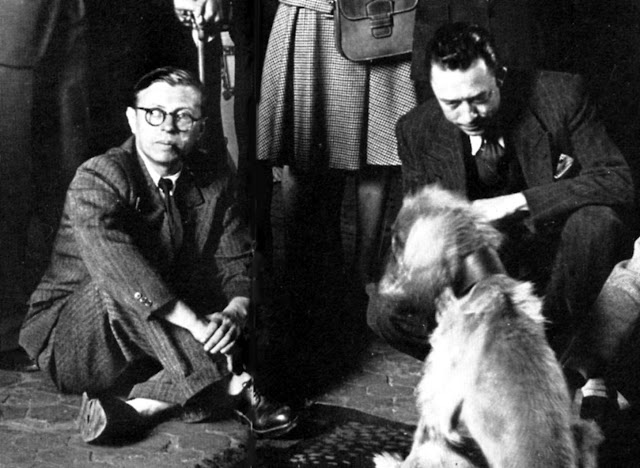
Jean-Paul Sartre
Directions: In preparation for our unit on The Stranger by Albert Camus, please read the following essay on Existentialism by Jean-Paul Sartre and compose a detailed response using evidence from the essay in your piece.
Three Stages of Existentialism
Humans in Anguish: "The man who involves himself and who
realizes that he is not only the person he chooses to be, but also a law-maker
who is, at the same time, choosing all mankind as well as himself, cannot help
escape the feeling of his total and deep responsibility. Of course there are many people who are not
anxious; but we claim they are hiding their anxiety, that they are fleeing from
it....Anguish is evident, even when it conceals itself."
Humans in
Forlornness: "When we speak
of forlornness, we mean only that God does not exist and that we have to face
all the consequences of this....The existentialist thinks it very distressing
that God does not exist, because all possibility of finding values in a heaven
of ideas disappears along with Him; there can no longer an a priori Good, since
there is no infinite and perfect consciousness to think it. Nowhere is it written that the Good exists,
that we must be honest, that we must not lie; because the fact is we are on a
plane where there are only men....Neither within him or without does man find
anything to cling to. He can't start
making excuses for himself.
Humans in Despair: "As for despair, the term has a very
simple meaning. It means that we shall
confine ourselves to reckoning only with what depends upon our will, or on the
ensemble of probabilities which make our action possible....No God, no scheme,
can adapt the world and its possibilities to my will."
“Existentialism Is a Humanism”
By Jean-Paul Sartre
Written: Lecture given in 1946
Source: Existentialism from Dostoyevsky to Sartre,
ed. Walter Kaufman, Meridian Publishing Company, 1989;
First Published: World Publishing Company in 1956;
Translator: Philip Mairet;
My purpose here is to offer a defense of existentialism
against several reproaches that have been laid against it.
First, it has been reproached as an invitation to people to
dwell in quietism of despair. For if every way to a solution is barred, one
would have to regard any action in this world as entirely ineffective, and one
would arrive finally at a contemplative philosophy. Moreover, since
contemplation is a luxury, this would be only another bourgeois philosophy.
This is, especially, the reproach made by the Communists.
From another quarter we are reproached for having underlined
all that is ignominious in the human situation, for depicting what is mean,
sordid or base to the neglect of certain things that possess charm and beauty
and belong to the brighter side of human nature: for example, according to the
Catholic critic, Mlle. Mercier, we forget how an infant smiles. Both from this
side and from the other we are also reproached for leaving out of account the
solidarity of mankind and considering man in isolation. And this, say the
Communists, is because we base our doctrine upon pure subjectivity – upon the
Cartesian “I think”: which is the moment in which solitary man attains to
himself; a position from which it is impossible to regain solidarity with other
men who exist outside of the self. The ego cannot reach them through the
cogito.
From the Christian side, we are reproached as people who
deny the reality and seriousness of human affairs. For since we ignore the
commandments of God and all values prescribed as eternal, nothing remains but
what is strictly voluntary. Everyone can do what he likes, and will be
incapable, from such a point of view, of condemning either the point of view or
the action of anyone else.
It is to these various reproaches that I shall endeavour to
reply today; that is why I have entitled this brief exposition “Existentialism
is a Humanism.” Many may be surprised at the mention of humanism in this
connection, but we shall try to see in what sense we understand it. In any
case, we can begin by saying that existentialism, in our sense of the word, is
a doctrine that does render human life possible; a doctrine, also, which
affirms that every truth and every action imply both an environment and a human
subjectivity. The essential charge laid against us is, of course, that of
over-emphasis upon the evil side of human life. I have lately been told of a
lady who, whenever she lets slip a vulgar expression in a moment of
nervousness, excuses herself by exclaiming, “I believe I am becoming an
existentialist.” So it appears that ugliness is being identified with
existentialism. That is why some people say we are “naturalistic,” and if we
are, it is strange to see how much we scandalise and horrify them, for no one seems
to be much frightened or humiliated nowadays by what is properly called
naturalism. Those who can quite well keep down a novel by Zola such as La Terre
are sickened as soon as they read an existentialist novel. Those who appeal to
the wisdom of the people – which is a sad wisdom – find ours sadder still. And
yet, what could be more disillusioned than such sayings as “Charity begins at
home” or “Promote a rogue and he’ll sue you for damage, knock him down and
he’ll do you homage”? We all know how many common sayings can be quoted to this
effect, and they all mean much the same – that you must not oppose the powers
that be; that you must not fight against superior force; must not meddle in
matters that are above your station. Or that any action not in accordance with
some tradition is mere romanticism; or that any undertaking which has not the
support of proven experience is foredoomed to frustration; and that since
experience has shown men to be invariably inclined to evil, there must be firm
rules to restrain them, otherwise we shall have anarchy. It is, however, the
people who are forever mouthing these dismal proverbs and, whenever they are
told of some more or less repulsive action, say “How like human nature!” – it
is these very people, always harping upon realism, who complain that
existentialism is too gloomy a view of things. Indeed their excessive protests
make me suspect that what is annoying them is not so much our pessimism, but,
much more likely, our optimism. For at bottom, what is alarming in the doctrine
that I am about to try to explain to you is – is it not? – that it confronts
man with a possibility of choice. To verify this, let us review the whole
question upon the strictly philosophic level. What, then, is this that we call
existentialism?
Most of those who are making use of this word would be
highly confused if required to explain its meaning. For since it has become
fashionable, people cheerfully declare that this musician or that painter is
“existentialist.” A columnist in Clartes signs himself “The Existentialist,”
and, indeed, the word is now so loosely applied to so many things that it no
longer means anything at all. It would appear that, for the lack of any novel
doctrine such as that of surrealism, all those who are eager to join in the
latest scandal or movement now seize upon this philosophy in which, however,
they can find nothing to their purpose. For in truth this is of all teachings
the least scandalous and the most austere: it is intended strictly for
technicians and philosophers. All the same, it can easily be defined.
The question is only complicated because there are two kinds
of existentialists. There are, on the one hand, the Christians, amongst whom I
shall name Jaspers and Gabriel Marcel, both professed Catholics; and on the
other the existential atheists, amongst whom we must place Heidegger as well as
the French existentialists and myself. What they have in common is simply the
fact that they believe that existence comes before essence – or, if you will,
that we must begin from the subjective. What exactly do we mean by that?
If one considers an article of manufacture as, for example,
a book or a paper-knife – one sees that it has been made by an artisan who had
a conception of it; and he has paid attention, equally, to the conception of a
paper-knife and to the pre-existent technique of production which is a part of
that conception and is, at bottom, a formula. Thus the paper-knife is at the
same time an article producible in a certain manner and one which, on the other
hand, serves a definite purpose, for one cannot suppose that a man would
produce a paper-knife without knowing what it was for. Let us say, then, of the
paperknife that its essence – that is to say the sum of the formulae and the
qualities which made its production and its definition possible – precedes its
existence. The presence of such-and-such a paper-knife or book is thus
determined before my eyes. Here, then, we are viewing the world from a
technical standpoint, and we can say that production precedes existence.
When we think of God as the creator, we are thinking of him,
most of the time, as a supernal artisan. Whatever doctrine we may be
considering, whether it be a doctrine like that of Descartes, or of Leibnitz
himself, we always imply that the will follows, more or less, from the
understanding or at least accompanies it, so that when God creates he knows
precisely what he is creating. Thus, the conception of man in the mind of God
is comparable to that of the paper-knife in the mind of the artisan: God makes
man according to a procedure and a conception, exactly as the artisan
manufactures a paper-knife, following a definition and a formula. Thus each
individual man is the realisation of a certain conception which dwells in the
divine understanding. In the philosophic atheism of the eighteenth century, the
notion of God is suppressed, but not, for all that, the idea that essence is
prior to existence; something of that idea we still find everywhere, in
Diderot, in Voltaire and even in Kant. Man possesses a human nature; that
“human nature,” which is the conception of human being, is found in every man;
which means that each man is a particular example of a universal conception,
the conception of Man. In Kant, this universality goes so far that the wild man
of the woods, man in the state of nature and the bourgeois are all contained in
the same definition and have the same fundamental qualities. Here again, the
essence of man precedes that historic existence which we confront in
experience.
Atheistic existentialism, of which I am a representative,
declares with greater consistency that if God does not exist there is at least
one being whose existence comes before its essence, a being which exists before
it can be defined by any conception of it. That being is man or, as Heidegger
has it, the human reality. What do we mean by saying that existence precedes
essence? We mean that man first of all exists, encounters himself, surges up in
the world – and defines himself afterwards. If man as the existentialist sees
him is not definable, it is because to begin with he is nothing. He will not be
anything until later, and then he will be what he makes of himself. Thus, there
is no human nature, because there is no God to have a conception of it. Man
simply is. Not that he is simply what he conceives himself to be, but he is
what he wills, and as he conceives himself after already existing – as he wills
to be after that leap towards existence. Man is nothing else but that which he
makes of himself. That is the first principle of existentialism. And this is
what people call its “subjectivity,” using the word as a reproach against us.
But what do we mean to say by this, but that man is of a greater dignity than a
stone or a table? For we mean to say that man primarily exists – that man is,
before all else, something which propels itself towards a future and is aware
that it is doing so. Man is, indeed, a project which possesses a subjective
life, instead of being a kind of moss, or a fungus or a cauliflower. Before
that projection of the self nothing exists; not even in the heaven of
intelligence: man will only attain existence when he is what he purposes to be.
Not, however, what he may wish to be. For what we usually understand by wishing
or willing is a conscious decision taken – much more often than not – after we
have made ourselves what we are. I may wish to join a party, to write a book or
to marry – but in such a case what is usually called my will is probably a
manifestation of a prior and more spontaneous decision. If, however, it is true
that existence is prior to essence, man is responsible for what he is. Thus,
the first effect of existentialism is that it puts every man in possession of
himself as he is, and places the entire responsibility for his existence
squarely upon his own shoulders. And, when we say that man is responsible for
himself, we do not mean that he is responsible only for his own individuality,
but that he is responsible for all men. The word “subjectivism” is to be
understood in two senses, and our adversaries play upon only one of them.
Subjectivism means, on the one hand, the freedom of the individual subject and,
on the other, that man cannot pass beyond human subjectivity. It is the latter
which is the deeper meaning of existentialism. When we say that man chooses
himself, we do mean that every one of us must choose himself; but by that we
also mean that in choosing for himself he chooses for all men. For in effect,
of all the actions a man may take in order to create himself as he wills to be,
there is not one which is not creative, at the same time, of an image of man
such as he believes he ought to be. To choose between this or that is at the
same time to affirm the value of that which is chosen; for we are unable ever
to choose the worse. What we choose is always the better; and nothing can be
better for us unless it is better for all. If, moreover, existence precedes
essence and we will to exist at the same time as we fashion our image, that
image is valid for all and for the entire epoch in which we find ourselves. Our
responsibility is thus much greater than we had supposed, for it concerns
mankind as a whole. If I am a worker, for instance, I may choose to join a
Christian rather than a Communist trade union. And if, by that membership, I
choose to signify that resignation is, after all, the attitude that best
becomes a man, that man’s kingdom is not upon this earth, I do not commit
myself alone to that view. Resignation is my will for everyone, and my action
is, in consequence, a commitment on behalf of all mankind. Or if, to take a
more personal case, I decide to marry and to have children, even though this
decision proceeds simply from my situation, from my passion or my desire, I am
thereby committing not only myself, but humanity as a whole, to the practice of
monogamy. I am thus responsible for myself and for all men, and I am creating a
certain image of man as I would have him to be. In fashioning myself I fashion
man.
This may enable us to understand what is meant by such terms
– perhaps a little grandiloquent – as anguish, abandonment and despair. As you
will soon see, it is very simple. First, what do we mean by anguish? – The
existentialist frankly states that man is in anguish. His meaning is as
follows: When a man commits himself to anything, fully realising that he is not
only choosing what he will be, but is thereby at the same time a legislator
deciding for the whole of mankind – in such a moment a man cannot escape from
the sense of complete and profound responsibility. There are many, indeed, who
show no such anxiety. But we affirm that they are merely disguising their
anguish or are in flight from it. Certainly, many people think that in what
they are doing they commit no one but themselves to anything: and if you ask
them, “What would happen if everyone did so?” they shrug their shoulders and
reply, “Everyone does not do so.” But in truth, one ought always to ask oneself
what would happen if everyone did as one is doing; nor can one escape from that
disturbing thought except by a kind of self-deception. The man who lies in
self-excuse, by saying “Everyone will not do it” must be ill at ease in his
conscience, for the act of lying implies the universal value which it denies.
By its very disguise his anguish reveals itself. This is the anguish that
Kierkegaard called “the anguish of Abraham.” You know the story: An angel
commanded Abraham to sacrifice his son; and obedience was obligatory, if it
really was an angel who had appeared and said, “Thou, Abraham, shalt sacrifice
thy son.” But anyone in such a case would wonder, first, whether it was indeed
an angel and secondly, whether I am really Abraham. Where are the proofs? A
certain mad woman who suffered from hallucinations said that people were
telephoning to her, and giving her orders. The doctor asked, “But who is it
that speaks to you?” She replied: “He says it is God.” And what, indeed, could
prove to her that it was God? If an angel appears to me, what is the proof that
it is an angel; or, if I hear voices, who can prove that they proceed from
heaven and not from hell, or from my own subconsciousness or some pathological
condition? Who can prove that they are really addressed to me?
Who, then, can prove that I am the proper person to impose,
by my own choice, my conception of man upon mankind? I shall never find any
proof whatever; there will be no sign to convince me of it. If a voice speaks
to me, it is still I myself who must decide whether the voice is or is not that
of an angel. If I regard a certain course of action as good, it is only I who
choose to say that it is good and not bad. There is nothing to show that I am
Abraham: nevertheless I also am obliged at every instant to perform actions
which are examples. Everything happens to every man as though the whole human
race had its eyes fixed upon what he is doing and regulated its conduct
accordingly. So every man ought to say, “Am I really a man who has the right to
act in such a manner that humanity regulates itself by what I do.” If a man
does not say that, he is dissembling his anguish. Clearly, the anguish with
which we are concerned here is not one that could lead to quietism or inaction.
It is anguish pure and simple, of the kind well known to all those who have
borne responsibilities. When, for instance, a military leader takes upon
himself the responsibility for an attack and sends a number of men to their
death, he chooses to do it and at bottom he alone chooses. No doubt under a
higher command, but its orders, which are more general, require interpretation
by him and upon that interpretation depends the life of ten, fourteen or twenty
men. In making the decision, he cannot but feel a certain anguish. All leaders
know that anguish. It does not prevent their acting, on the contrary it is the
very condition of their action, for the action presupposes that there is a
plurality of possibilities, and in choosing one of these, they realize that it
has value only because it is chosen. Now it is anguish of that kind which
existentialism describes, and moreover, as we shall see, makes explicit through
direct responsibility towards other men who are concerned. Far from being a
screen which could separate us from action, it is a condition of action itself.
And when we speak of “abandonment” – a favorite word of Heidegger
– we only mean to say that God does not exist, and that it is necessary to draw
the consequences of his absence right to the end. The existentialist is
strongly opposed to a certain type of secular moralism which seeks to suppress
God at the least possible expense. Towards 1880, when the French professors
endeavoured to formulate a secular morality, they said something like this: God
is a useless and costly hypothesis, so we will do without it. However, if we
are to have morality, a society and a law-abiding world, it is essential that
certain values should be taken seriously; they must have an a priori existence
ascribed to them. It must be considered obligatory a priori to be honest, not
to lie, not to beat one’s wife, to bring up children and so forth; so we are
going to do a little work on this subject, which will enable us to show that
these values exist all the same, inscribed in an intelligible heaven although,
of course, there is no God. In other words – and this is, I believe, the
purport of all that we in France call radicalism – nothing will be changed if
God does not exist; we shall rediscover the same norms of honesty, progress and
humanity, and we shall have disposed of God as an out-of-date hypothesis which
will die away quietly of itself. The existentialist, on the contrary, finds it
extremely embarrassing that God does not exist, for there disappears with Him
all possibility of finding values in an intelligible heaven. There can no
longer be any good a priori, since there is no infinite and perfect
consciousness to think it. It is nowhere written that “the good” exists, that
one must be honest or must not lie, since we are now upon the plane where there
are only men. Dostoevsky once wrote: “If God did not exist, everything would be
permitted”; and that, for existentialism, is the starting point. Everything is
indeed permitted if God does not exist, and man is in consequence forlorn, for
he cannot find anything to depend upon either within or outside himself. He
discovers forthwith, that he is without excuse. For if indeed existence
precedes essence, one will never be able to explain one’s action by reference
to a given and specific human nature; in other words, there is no determinism –
man is free, man is freedom. Nor, on the other hand, if God does not exist, are
we provided with any values or commands that could legitimise our behaviour.
Thus we have neither behind us, nor before us in a luminous realm of values,
any means of justification or excuse. – We are left alone, without excuse. That
is what I mean when I say that man is condemned to be free. Condemned, because
he did not create himself, yet is nevertheless at liberty, and from the moment
that he is thrown into this world he is responsible for everything he does. The
existentialist does not believe in the power of passion. He will never regard a
grand passion as a destructive torrent upon which a man is swept into certain
actions as by fate, and which, therefore, is an excuse for them. He thinks that
man is responsible for his passion. Neither will an existentialist think that a
man can find help through some sign being vouchsafed upon earth for his
orientation: for he thinks that the man himself interprets the sign as he
chooses. He thinks that every man, without any support or help whatever, is
condemned at every instant to invent man. As Ponge has written in a very fine
article, “Man is the future of man.” That is exactly true. Only, if one took
this to mean that the future is laid up in Heaven, that God knows what it is,
it would be false, for then it would no longer even be a future. If, however,
it means that, whatever man may now appear to be, there is a future to be
fashioned, a virgin future that awaits him – then it is a true saying. But in
the present one is forsaken.
As an example by which you may the better understand this
state of abandonment, I will refer to the case of a pupil of mine, who sought
me out in the following circumstances. His father was quarrelling with his
mother and was also inclined to be a “collaborator”; his elder brother had been
killed in the German offensive of 1940 and this young man, with a sentiment
somewhat primitive but generous, burned to avenge him. His mother was living
alone with him, deeply afflicted by the semi-treason of his father and by the
death of her eldest son, and her one consolation was in this young man. But he,
at this moment, had the choice between going to England to join the Free French
Forces or of staying near his mother and helping her to live. He fully realised
that this woman lived only for him and that his disappearance – or perhaps his
death – would plunge her into despair. He also realised that, concretely and in
fact, every action he performed on his mother’s behalf would be sure of effect
in the sense of aiding her to live, whereas anything he did in order to go and
fight would be an ambiguous action which might vanish like water into sand and
serve no purpose. For instance, to set out for England he would have to wait
indefinitely in a Spanish camp on the way through Spain; or, on arriving in
England or in Algiers he might be put into an office to fill up forms.
Consequently, he found himself confronted by two very different modes of
action; the one concrete, immediate, but directed towards only one individual;
and the other an action addressed to an end infinitely greater, a national
collectivity, but for that very reason ambiguous – and it might be frustrated
on the way. At the same time, he was hesitating between two kinds of morality;
on the one side the morality of sympathy, of personal devotion and, on the
other side, a morality of wider scope but of more debatable validity. He had to
choose between those two. What could help him to choose? Could the Christian
doctrine? No. Christian doctrine says: Act with charity, love your neighbour,
deny yourself for others, choose the way which is hardest, and so forth. But
which is the harder road? To whom does one owe the more brotherly love, the
patriot or the mother? Which is the more useful aim, the general one of fighting
in and for the whole community, or the precise aim of helping one particular
person to live? Who can give an answer to that a priori? No one. Nor is it
given in any ethical scripture. The Kantian ethic says, Never regard another as
a means, but always as an end. Very well; if I remain with my mother, I shall
be regarding her as the end and not as a means: but by the same token I am in
danger of treating as means those who are fighting on my behalf; and the
converse is also true, that if I go to the aid of the combatants I shall be
treating them as the end at the risk of treating my mother as a means. If
values are uncertain, if they are still too abstract to determine the
particular, concrete case under consideration, nothing remains but to trust in
our instincts. That is what this young man tried to do; and when I saw him he
said, “In the end, it is feeling that counts; the direction in which it is
really pushing me is the one I ought to choose. If I feel that I love my mother
enough to sacrifice everything else for her – my will to be avenged, all my
longings for action and adventure then I stay with her. If, on the contrary, I
feel that my love for her is not enough, I go.” But how does one estimate the
strength of a feeling? The value of his feeling for his mother was determined
precisely by the fact that he was standing by her. I may say that I love a
certain friend enough to sacrifice such or such a sum of money for him, but I
cannot prove that unless I have done it. I may say, “I love my mother enough to
remain with her,” if actually I have remained with her. I can only estimate the
strength of this affection if I have performed an action by which it is defined
and ratified. But if I then appeal to this affection to justify my action, I
find myself drawn into a vicious circle.
Moreover, as Gide has very well said, a sentiment which is
play-acting and one which is vital are two things that are hardly
distinguishable one from another. To decide that I love my mother by staying
beside her, and to play a comedy the upshot of which is that I do so – these
are nearly the same thing. In other words, feeling is formed by the deeds that
one does; therefore I cannot consult it as a guide to action. And that is to
say that I can neither seek within myself for an authentic impulse to action,
nor can I expect, from some ethic, formulae that will enable me to act. You may
say that the youth did, at least, go to a professor to ask for advice. But if
you seek counsel – from a priest, for example you have selected that priest;
and at bottom you already knew, more or less, what he would advise. In other
words, to choose an adviser is nevertheless to commit oneself by that choice.
If you are a Christian, you will say, consult a priest; but there are
collaborationists, priests who are resisters and priests who wait for the tide
to turn: which will you choose? Had this young man chosen a priest of the
resistance, or one of the collaboration, he would have decided beforehand the
kind of advice he was to receive. Similarly, in coming to me, he knew what
advice I should give him, and I had but one reply to make. You are free,
therefore choose, that is to say, invent. No rule of general morality can show
you what you ought to do: no signs are vouchsafed in this world. The Catholics
will reply, “Oh, but they are!” Very well; still, it is I myself, in every
case, who have to interpret the signs. While I was imprisoned, I made the
acquaintance of a somewhat remarkable man, a Jesuit, who had become a member of
that order in the following manner. In his life he had suffered a succession of
rather severe setbacks. His father had died when he was a child, leaving him in
poverty, and he had been awarded a free scholarship in a religious institution,
where he had been made continually to feel that he was accepted for charity’s
sake, and, in consequence, he had been denied several of those distinctions and
honours which gratify children. Later, about the age of eighteen, he came to
grief in a sentimental affair; and finally, at twenty-two – this was a trifle
in itself, but it was the last drop that overflowed his cup – he failed in his
military examination. This young man, then, could regard himself as a total
failure: it was a sign – but a sign of what? He might have taken refuge in
bitterness or despair. But he took it – very cleverly for him – as a sign that
he was not intended for secular success, and that only the attainments of
religion, those of sanctity and of faith, were accessible to him. He
interpreted his record as a message from God, and became a member of the Order.
Who can doubt but that this decision as to the meaning of the sign was his, and
his alone? One could have drawn quite different conclusions from such a series
of reverses – as, for example, that he had better become a carpenter or a
revolutionary. For the decipherment of the sign, however, he bears the entire
responsibility. That is what “abandonment” implies, that we ourselves decide
our being. And with this abandonment goes anguish.
As for “despair,” the meaning of this expression is
extremely simple. It merely means that we limit ourselves to a reliance upon
that which is within our wills, or within the sum of the probabilities which
render our action feasible. Whenever one wills anything, there are always these
elements of probability. If I am counting upon a visit from a friend, who may
be coming by train or by tram, I presuppose that the train will arrive at the
appointed time, or that the tram will not be derailed. I remain in the realm of
possibilities; but one does not rely upon any possibilities beyond those that
are strictly concerned in one’s action. Beyond the point at which the
possibilities under consideration cease to affect my action, I ought to
disinterest myself. For there is no God and no prevenient design, which can
adapt the world and all its possibilities to my will. When Descartes said,
“Conquer yourself rather than the world,” what he meant was, at bottom, the
same – that we should act without hope.
Marxists, to whom I have said this, have answered: “Your
action is limited, obviously, by your death; but you can rely upon the help of
others. That is, you can count both upon what the others are doing to help you
elsewhere, as in China and in Russia, and upon what they will do later, after
your death, to take up your action and carry it forward to its final
accomplishment which will be the revolution. Moreover you must rely upon this;
not to do so is immoral.” To this I rejoin, first, that I shall always count
upon my comrades-in-arms in the struggle, in so far as they are committed, as I
am, to a definite, common cause; and in the unity of a party or a group which I
can more or less control – that is, in which I am enrolled as a militant and
whose movements at every moment are known to me. In that respect, to rely upon
the unity and the will of the party is exactly like my reckoning that the train
will run to time or that the tram will not be derailed. But I cannot count upon
men whom I do not know, I cannot base my confidence upon human goodness or upon
man’s interest in the good of society, seeing that man is free and that there
is no human nature which I can take as foundational. I do not know where the
Russian revolution will lead. I can admire it and take it as an example in so
far as it is evident, today, that the proletariat plays a part in Russia which
it has attained in no other nation. But I cannot affirm that this will
necessarily lead to the triumph of the proletariat: I must confine myself to
what I can see. Nor can I be sure that comrades-in-arms will take up my work
after my death and carry it to the maximum perfection, seeing that those men
are free agents and will freely decide, tomorrow, what man is then to be.
Tomorrow, after my death, some men may decide to establish Fascism, and the
others may be so cowardly or so slack as to let them do so. If so, Fascism will
then be the truth of man, and so much the worse for us. In reality, things will
be such as men have decided they shall be. Does that mean that I should abandon
myself to quietism? No. First I ought to commit myself and then act my
commitment, according to the time-honoured formula that “one need not hope in
order to undertake one’s work.” Nor does this mean that I should not belong to
a party, but only that I should be without illusion and that I should do what I
can. For instance, if I ask myself “Will the social ideal as such, ever become
a reality?” I cannot tell, I only know that whatever may be in my power to make
it so, I shall do; beyond that, I can count upon nothing.
Quietism is the attitude of people who say, “let others do
what I cannot do.” The doctrine I am presenting before you is precisely the
opposite of this, since it declares that there is no reality except in action.
It goes further, indeed, and adds, “Man is nothing else but what he purposes,
he exists only in so far as he realises himself, he is therefore nothing else
but the sum of his actions, nothing else but what his life is.” Hence we can
well understand why some people are horrified by our teaching. For many have
but one resource to sustain them in their misery, and that is to think,
“Circumstances have been against me, I was worthy to be something much better
than I have been. I admit I have never had a great love or a great friendship;
but that is because I never met a man or a woman who were worthy of it; if I
have not written any very good books, it is because I had not the leisure to do
so; or, if I have had no children to whom I could devote myself it is because I
did not find the man I could have lived with. So there remains within me a wide
range of abilities, inclinations and potentialities, unused but perfectly
viable, which endow me with a worthiness that could never be inferred from the
mere history of my actions.” But in reality and for the existentialist, there
is no love apart from the deeds of love; no potentiality of love other than
that which is manifested in loving; there is no genius other than that which is
expressed in works of art. The genius of Proust is the totality of the works of
Proust; the genius of Racine is the series of his tragedies, outside of which
there is nothing. Why should we attribute to Racine the capacity to write yet
another tragedy when that is precisely what he did not write? In life, a man
commits himself, draws his own portrait and there is nothing but that portrait.
No doubt this thought may seem comfortless to one who has not made a success of
his life. On the other hand, it puts everyone in a position to understand that
reality alone is reliable; that dreams, expectations and hopes serve to define
a man only as deceptive dreams, abortive hopes, expectations unfulfilled; that
is to say, they define him negatively, not positively. Nevertheless, when one
says, “You are nothing else but what you live,” it does not imply that an
artist is to be judged solely by his works of art, for a thousand other things
contribute no less to his definition as a man. What we mean to say is that a
man is no other than a series of undertakings, that he is the sum, the
organisation, the set of relations that constitute these undertakings.
In the light of all this, what people reproach us with is
not, after all, our pessimism, but the sternness of our optimism. If people
condemn our works of fiction, in which we describe characters that are base,
weak, cowardly and sometimes even frankly evil, it is not only because those
characters are base, weak, cowardly or evil. For suppose that, like Zola, we
showed that the behaviour of these characters was caused by their heredity, or
by the action of their environment upon them, or by determining factors,
psychic or organic. People would be reassured, they would say, “You see, that
is what we are like, no one can do anything about it.” But the existentialist,
when he portrays a coward, shows him as responsible for his cowardice. He is
not like that on account of a cowardly heart or lungs or cerebrum, he has not
become like that through his physiological organism; he is like that because he
has made himself into a coward by actions. There is no such thing as a cowardly
temperament. There are nervous temperaments; there is what is called
impoverished blood, and there are also rich temperaments. But the man whose
blood is poor is not a coward for all that, for what produces cowardice is the
act of giving up or giving way; and a temperament is not an action. A coward is
defined by the deed that he has done. What people feel obscurely, and with
horror, is that the coward as we present him is guilty of being a coward. What
people would prefer would be to be born either a coward or a hero. One of the
charges most often laid against the Chemins de la Liberté is something like
this: “But, after all, these people being so base, how can you make them into
heroes?” That objection is really rather comic, for it implies that people are
born heroes: and that is, at bottom, what such people would like to think. If
you are born cowards, you can be quite content, you can do nothing about it and
you will be cowards all your lives whatever you do; and if you are born heroes
you can again be quite content; you will be heroes all your lives eating and
drinking heroically. Whereas the existentialist says that the coward makes
himself cowardly, the hero makes himself heroic; and that there is always a
possibility for the coward to give up cowardice and for the hero to stop being
a hero. What counts is the total commitment, and it is not by a particular case
or particular action that you are committed altogether.
We have now, I think, dealt with a certain number of the
reproaches against existentialism. You have seen that it cannot be regarded as
a philosophy of quietism since it defines man by his action; nor as a
pessimistic description of man, for no doctrine is more optimistic, the destiny
of man is placed within himself. Nor is it an attempt to discourage man from
action since it tells him that there is no hope except in his action, and that
the one thing which permits him to have life is the deed. Upon this level
therefore, what we are considering is an ethic of action and self-commitment.
However, we are still reproached, upon these few data, for confining man within
his individual subjectivity. There again people badly misunderstand us.
Our point of departure is, indeed, the subjectivity of the
individual, and that for strictly philosophic reasons. It is not because we are
bourgeois, but because we seek to base our teaching upon the truth, and not
upon a collection of fine theories, full of hope but lacking real foundations.
And at the point of departure there cannot be any other truth than this, I
think, therefore I am, which is the absolute truth of consciousness as it
attains to itself. Every theory which begins with man, outside of this moment
of self-attainment, is a theory which thereby suppresses the truth, for outside
of the Cartesian cogito, all objects are no more than probable, and any
doctrine of probabilities which is not attached to a truth will crumble into
nothing. In order to define the probable one must possess the true. Before
there can be any truth whatever, then, there must be an absolute truth, and
there is such a truth which is simple, easily attained and within the reach of
everybody; it consists in one’s immediate sense of one’s self.
In the second place, this theory alone is compatible with
the dignity of man, it is the only one which does not make man into an object.
All kinds of materialism lead one to treat every man including oneself as an
object – that is, as a set of pre-determined reactions, in no way different
from the patterns of qualities and phenomena which constitute a table, or a
chair or a stone. Our aim is precisely to establish the human kingdom as a
pattern of values in distinction from the material world. But the subjectivity
which we thus postulate as the standard of truth is no narrowly individual
subjectivism, for as we have demonstrated, it is not only one’s own self that
one discovers in the cogito, but those of others too. Contrary to the
philosophy of Descartes, contrary to that of Kant, when we say “I think” we are
attaining to ourselves in the presence of the other, and we are just as certain
of the other as we are of ourselves. Thus the man who discovers himself
directly in the cogito also discovers all the others, and discovers them as the
condition of his own existence. He recognises that he cannot be anything (in
the sense in which one says one is spiritual, or that one is wicked or jealous)
unless others recognise him as such. I cannot obtain any truth whatsoever about
myself, except through the mediation of another. The other is indispensable to
my existence, and equally so to any knowledge I can have of myself. Under these
conditions, the intimate discovery of myself is at the same time the revelation
of the other as a freedom which confronts mine, and which cannot think or will
without doing so either for or against me. Thus, at once, we find ourselves in
a world which is, let us say, that of “inter-subjectivity”. It is in this world
that man has to decide what he is and what others are.
Furthermore, although it is impossible to find in each and
every man a universal essence that can be called human nature, there is
nevertheless a human universality of condition. It is not by chance that the
thinkers of today are so much more ready to speak of the condition than of the
nature of man. By his condition they understand, with more or less clarity, all
the limitations which a priori define man’s fundamental situation in the
universe. His historical situations are variable: man may be born a slave in a
pagan society or may be a feudal baron, or a proletarian. But what never vary
are the necessities of being in the world, of having to labor and to die there.
These limitations are neither subjective nor objective, or rather there is both
a subjective and an objective aspect of them. Objective, because we meet with
them everywhere and they are everywhere recognisable: and subjective because
they are lived and are nothing if man does not live them – if, that is to say,
he does not freely determine himself and his existence in relation to them.
And, diverse though man’s purpose may be, at least none of them is wholly
foreign to me, since every human purpose presents itself as an attempt either
to surpass these limitations, or to widen them, or else to deny or to
accommodate oneself to them. Consequently every purpose, however individual it
may be, is of universal value. Every purpose, even that of a Chinese, an Indian
or a Negro, can be understood by a European. To say it can be understood, means
that the European of 1945 may be striving out of a certain situation towards
the same limitations in the same way, and that he may reconceive in himself the
purpose of the Chinese, of the Indian or the African. In every purpose there is
universality, in this sense that every purpose is comprehensible to every man.
Not that this or that purpose defines man for ever, but that it may be
entertained again and again. There is always some way of understanding an
idiot, a child, a primitive man or a foreigner if one has sufficient
information. In this sense we may say that there is a human universality, but
it is not something given; it is being perpetually made. I make this
universality in choosing myself; I also make it by understanding the purpose of
any other man, of whatever epoch. This absoluteness of the act of choice does
not alter the relativity of each epoch.
What is at the very heart and center of existentialism, is
the absolute character of the free commitment, by which every man realises
himself in realising a type of humanity – a commitment always understandable,
to no matter whom in no matter what epoch – and its bearing upon the relativity
of the cultural pattern which may result from such absolute commitment. One
must observe equally the relativity of Cartesianism and the absolute character
of the Cartesian commitment. In this sense you may say, if you like, that every
one of us makes the absolute by breathing, by eating, by sleeping or by
behaving in any fashion whatsoever. There is no difference between free being –
being as self-committal, as existence choosing its essence – and absolute
being. And there is no difference whatever between being as an absolute,
temporarily localised that is, localised in history – and universally
intelligible being.
This does not completely refute the charge of subjectivism.
Indeed that objection appears in several other forms, of which the first is as
follows. People say to us, “Then it does not matter what you do,” and they say
this in various ways.
First they tax us with anarchy; then they say, “You cannot
judge others, for there is no reason for preferring one purpose to another”;
finally, they may say, “Everything being merely voluntary in this choice of
yours, you give away with one hand what you pretend to gain with the other.”
These three are not very serious objections. As to the first, to say that it
does not matter what you choose is not correct. In one sense choice is
possible, but what is not possible is not to choose. I can always choose, but I
must know that if I do not choose, that is still a choice. This, although it
may appear merely formal, is of great importance as a limit to fantasy and
caprice. For, when I confront a real situation – for example, that I am a
sexual being, able to have relations with a being of the other sex and able to
have children – I am obliged to choose my attitude to it, and in every respect
I bear the responsibility of the choice which, in committing myself, also
commits the whole of humanity. Even if my choice is determined by no a priori
value whatever, it can have nothing to do with caprice: and if anyone thinks
that this is only Gide’s theory of the acte gratuit over again, he has failed
to see the enormous difference between this theory and that of Gide. Gide does
not know what a situation is, his “act” is one of pure caprice. In our view, on
the contrary, man finds himself in an organised situation in which he is
himself involved: his choice involves mankind in its entirety, and he cannot
avoid choosing. Either he must remain single, or he must marry without having children,
or he must marry and have children. In any case, and whichever he may choose,
it is impossible for him, in respect of this situation, not to take complete
responsibility. Doubtless he chooses without reference to any pre-established
value, but it is unjust to tax him with caprice. Rather let us say that the
moral choice is comparable to the construction of a work of art.
But here I must at once digress to make it quite clear that
we are not propounding an aesthetic morality, for our adversaries are
disingenuous enough to reproach us even with that. I mention the work of art
only by way of comparison. That being understood, does anyone reproach an
artist, when he paints a picture, for not following rules established a priori.
Does one ever ask what is the picture that he ought to paint? As everyone
knows, there is no pre-defined picture for him to make; the artist applies
himself to the composition of a picture, and the picture that ought to be made
is precisely that which he will have made. As everyone knows, there are no
aesthetic values a priori, but there are values which will appear in due course
in the coherence of the picture, in the relation between the will to create and
the finished work. No one can tell what the painting of tomorrow will be like;
one cannot judge a painting until it is done. What has that to do with
morality? We are in the same creative situation. We never speak of a work of
art as irresponsible; when we are discussing a canvas by Picasso, we understand
very well that the composition became what it is at the time when he was
painting it, and that his works are part and parcel of his entire life.
It is the same upon the plane of morality. There is this in
common between art and morality, that in both we have to do with creation and
invention. We cannot decide a priori what it is that should be done. I think it
was made sufficiently clear to you in the case of that student who came to see
me, that to whatever ethical system he might appeal, the Kantian or any other,
he could find no sort of guidance whatever; he was obliged to invent the law
for himself. Certainly we cannot say that this man, in choosing to remain with
his mother – that is, in taking sentiment, personal devotion and concrete
charity as his moral foundations – would be making an irresponsible choice, nor
could we do so if he preferred the sacrifice of going away to England. Man
makes himself; he is not found ready-made; he makes himself by the choice of
his morality, and he cannot but choose a morality, such is the pressure of
circumstances upon him. We define man only in relation to his commitments; it
is therefore absurd to reproach us for irresponsibility in our choice.
In the second place, people say to us, “You are unable to
judge others.” This is true in one sense and false in another. It is true in
this sense, that whenever a man chooses his purpose and his commitment in all
clearness and in all sincerity, whatever that purpose may be, it is impossible
for him to prefer another. It is true in the sense that we do not believe in
progress. Progress implies amelioration; but man is always the same, facing a
situation which is always changing, and choice remains always a choice in the
situation. The moral problem has not changed since the time when it was a choice
between slavery and anti-slavery – from the time of the war of Secession, for
example, until the present moment when one chooses between the M.R.P.
[Mouvement Republicain Poputaire] and the Communists.
We can judge, nevertheless, for, as I have said, one chooses
in view of others, and in view of others one chooses himself. One can judge,
first – and perhaps this is not a judgment of value, but it is a logical
judgment – that in certain cases choice is founded upon an error, and in others
upon the truth. One can judge a man by saying that he deceives himself. Since
we have defined the situation of man as one of free choice, without excuse and
without help, any man who takes refuge behind the excuse of his passions, or by
inventing some deterministic doctrine, is a self-deceiver. One may object: “But
why should he not choose to deceive himself?” I reply that it is not for me to
judge him morally, but I define his self-deception as an error. Here one cannot
avoid pronouncing a judgment of truth. The self-deception is evidently a
falsehood, because it is a dissimulation of man’s complete liberty of
commitment. Upon this same level, I say that it is also a self-deception if I
choose to declare that certain values are incumbent upon me; I am in
contradiction with myself if I will these values and at the same time say that
they impose themselves upon me. If anyone says to me, “And what if I wish to
deceive myself?” I answer, “There is no reason why you should not, but I
declare that you are doing so, and that the attitude of strict consistency
alone is that of good faith.” Furthermore, I can pronounce a moral judgment.
For I declare that freedom, in respect of concrete circumstances, can have no
other end and aim but itself; and when once a man has seen that values depend
upon himself, in that state of forsakenness he can will only one thing, and
that is freedom as the foundation of all values. That does not mean that he
wills it in the abstract: it simply means that the actions of men of good faith
have, as their ultimate significance, the quest of freedom itself as such. A
man who belongs to some communist or revolutionary society wills certain
concrete ends, which imply the will to freedom, but that freedom is willed in
community. We will freedom for freedom’s sake, in and through particular
circumstances. And in thus willing freedom, we discover that it depends
entirely upon the freedom of others and that the freedom of others depends upon
our own. Obviously, freedom as the definition of a man does not depend upon others,
but as soon as there is a commitment, I am obliged to will the liberty of
others at the same time as my own. I cannot make liberty my aim unless I make
that of others equally my aim. Consequently, when I recognise, as entirely
authentic, that man is a being whose existence precedes his essence, and that
he is a free being who cannot, in any circumstances, but will his freedom, at
the same time I realize that I cannot not will the freedom of others. Thus, in
the name of that will to freedom which is implied in freedom itself, I can form
judgments upon those who seek to hide from themselves the wholly voluntary
nature of their existence and its complete freedom. Those who hide from this
total freedom, in a guise of solemnity or with deterministic excuses, I shall
call cowards. Others, who try to show that their existence is necessary, when
it is merely an accident of the appearance of the human race on earth – I shall
call scum. But neither cowards nor scum can be identified except upon the plane
of strict authenticity. Thus, although the content of morality is variable, a
certain form of this morality is universal. Kant declared that freedom is a
will both to itself and to the freedom of others. Agreed: but he thinks that
the formal and the universal suffice for the constitution of a morality. We
think, on the contrary, that principles that are too abstract break down when
we come to defining action. To take once again the case of that student; by
what authority, in the name of what golden rule of morality, do you think he
could have decided, in perfect peace of mind, either to abandon his mother or
to remain with her? There are no means of judging. The content is always
concrete, and therefore unpredictable; it has always to be invented. The one
thing that counts, is to know whether the invention is made in the name of
freedom.
Let us, for example, examine the two following cases, and
you will see how far they are similar in spite of their difference. Let us take
The Mill on the Floss. We find here a certain young woman, Maggie Tulliver, who
is an incarnation of the value of passion and is aware of it. She is in love
with a young man, Stephen, who is engaged to another, an insignificant young
woman. This Maggie Tulliver, instead of heedlessly seeking her own happiness,
chooses in the name of human solidarity to sacrifice herself and to give up the
man she loves. On the other hand, La Sanseverina in Stendhal’s Chartreuse de
Parme, believing that it is passion which endows man with his real value, would
have declared that a grand passion justifies its sacrifices, and must be
preferred to the banality of such conjugal love as would unite Stephen to the
little goose he was engaged to marry. It is the latter that she would have
chosen to sacrifice in realising her own happiness, and, as Stendhal shows, she
would also sacrifice herself upon the plane of passion if life made that demand
upon her. Here we are facing two clearly opposed moralities; but I claim that
they are equivalent, seeing that in both cases the overruling aim is freedom.
You can imagine two attitudes exactly similar in effect, in that one girl might
prefer, in resignation, to give up her lover while the other preferred, in
fulfilment of sexual desire, to ignore the prior engagement of the man she loved;
and, externally, these two cases might appear the same as the two we have just
cited, while being in fact entirely different. The attitude of La Sanseverina
is much nearer to that of Maggie Tulliver than to one of careless greed. Thus,
you see, the second objection is at once true and false. One can choose
anything, but only if it is upon the plane of free commitment.
The third objection, stated by saying, “You take with one
hand what you give with the other,” means, at bottom, “your values are not serious,
since you choose them yourselves.” To that I can only say that I am very sorry
that it should be so; but if I have excluded God the Father, there must be
somebody to invent values. We have to take things as they are. And moreover, to
say that we invent values means neither more nor less than this; that there is
no sense in life a priori. Life is nothing until it is lived; but it is yours
to make sense of, and the value of it is nothing else but the sense that you
choose. Therefore, you can see that there is a possibility of creating a human
community. I have been reproached for suggesting that existentialism is a form
of humanism: people have said to me, “But you have written in your Nausée that
the humanists are wrong, you have even ridiculed a certain type of humanism,
why do you now go back upon that?” In reality, the word humanism has two very
different meanings. One may understand by humanism a theory which upholds man
as the end-in-itself and as the supreme value. Humanism in this sense appears,
for instance, in Cocteau’s story Round the World in 80 Hours, in which one of
the characters declares, because he is flying over mountains in an airplane,
“Man is magnificent!” This signifies that although I personally have not built
aeroplanes, I have the benefit of those particular inventions and that I
personally, being a man, can consider myself responsible for, and honoured by,
achievements that are peculiar to some men. It is to assume that we can ascribe
value to man according to the most distinguished deeds of certain men. That
kind of humanism is absurd, for only the dog or the horse would be in a
position to pronounce a general judgment upon man and declare that he is
magnificent, which they have never been such fools as to do – at least, not as
far as I know. But neither is it admissible that a man should pronounce
judgment upon Man. Existentialism dispenses with any judgment of this sort: an
existentialist will never take man as the end, since man is still to be
determined. And we have no right to believe that humanity is something to which
we could set up a cult, after the manner of Auguste Comte. The cult of humanity
ends in Comtian humanism, shut-in upon itself, and – this must be said – in
Fascism. We do not want a humanism like that.
But there is another sense of the word, of which the
fundamental meaning is this: Man is all the time outside of himself: it is in
projecting and losing himself beyond himself that he makes man to exist; and,
on the other hand, it is by pursuing transcendent aims that he himself is able
to exist. Since man is thus self-surpassing, and can grasp objects only in
relation to his self-surpassing, he is himself the heart and center of his
transcendence. There is no other universe except the human universe, the universe
of human subjectivity. This relation of transcendence as constitutive of man
(not in the sense that God is transcendent, but in the sense of
self-surpassing) with subjectivity (in such a sense that man is not shut up in
himself but forever present in a human universe) – it is this that we call
existential humanism. This is humanism, because we remind man that there is no
legislator but himself; that he himself, thus abandoned, must decide for
himself; also because we show that it is not by turning back upon himself, but
always by seeking, beyond himself, an aim which is one of liberation or of some
particular realisation, that man can realize himself as truly human.
You can see from these few reflections that nothing could be
more unjust than the objections people raise against us. Existentialism is
nothing else but an attempt to draw the full conclusions from a consistently
atheistic position. Its intention is not in the least that of plunging men into
despair. And if by despair one means as the Christians do – any attitude of
unbelief, the despair of the existentialists is something different.
Existentialism is not atheist in the sense that it would exhaust itself in
demonstrations of the non-existence of God. It declares, rather, that even if
God existed that would make no difference from its point of view. Not that we
believe God does exist, but we think that the real problem is not that of His
existence; what man needs is to find himself again and to understand that
nothing can save him from himself, not even a valid proof of the existence of
God. In this sense existentialism is optimistic. It is a doctrine of action,
and it is only by self-deception, by confining their own despair with ours that
Christians can describe us as without hope.
“The Myth of Sisyphus”
by Albert Camus
Wednesday, January 22, 2020
Mid-term Review: “Johnny Got His Gun” 2007 AP Prompt 2 Sample Essays

Sample NN
This passage from "Johnny Got His Gun," by Dalton Trumbo analyzes the relationship between young Joe and his father. The two of them had been fishing together for years, but this year Joe wanted to go fishing with his friend. Through third person point of view, careful selection of detail, and simple sentences Trumbo characterizes the deep but changing relationship of the father and son.
By telling the story from a third person point of view, Trumbo provides the reader with a more universal view of the father-son relationship. Readers are able to see the feelings of both father and son.
The phrases "For a little while his father didn't say a thing" and "I'm tired and I think I'll rest all day" show how saddened the father was by his son's actions. However, he felt so deeply for his son that he said, "so you use my and let Bill use yours." Thankfully, the love the father felt for his son was always shared by the son for his father. "He felt a little lump in his throat as the thought that even as deserting his father for Bill Harper his father had volunteered the rod." Because the passage is told from a third person viewpoint, we are able to see that they loved each other and wanted to continue fishing together; sadly, things can't stay the same forever.
Trumbo constructed this passage very carefully in order to show the changing dynamics of the father-son relationship. By starting the passage off with peaceful visuals of camping and fishing, Dalton gives the reader an idea of the joy that the father and son received from each other. The line "sitting across from him and staring into the fire was his father" furthers the notion that the son looked up to the father and enjoyed being with him. However, as the passage progresses an outsider, Bill Harper, enters the story. Although the son still loves his father, he feels a greater desire to be with his friend. Also Trumbo shows the love the father has for his son by telling how he is willing to let his son use his greatest possession. Lastly, the image of the son sneaking away "without awakening his father" provides the reader with an image of a son being pulled in different directions, and a father who will awaken to a long and lonely day.
Through the use of simple syntax, Trumbo further characterizes the relationship of the father and son while also serving to reinforce the peaceful and related imagery of the poem, the simple syntax has the effect of showing the reader how much of an impact a small action can have on a relationship. Although the father and son will always love each other, it will never be the same between them again. The son's simple action to go off with Bill Harper has forever changed their relationship. Other fishing trips will come, but the father will always be wondering if his son wants to be there with him or if he'd rather go fishing with Bill Harper.
Many little boys view their father as the greatest man in the world. Unfortunately, as they age, they begin to see his flaws; they desire to instead, hang around with kids their age. We need to remember that although relationships change, we should always stay close to those who have always been there for us.
Sample TT
During the maturing of a young male there is always a moment where one parts from his father only to learn that he is more like his father than he would like to let on. This convention is a staple of many works concerning the father and sun relationships and Johnny Got His Gun is no exception. Dalton Trumbo uses a third person point of view, detailed descriptions, and syntax that implies similarities to characterize the close relationship between a Youngman and his father.
Throughout the passage the author uses a third person point of view to show the relationship between the boy and his father. The author uses pronouns such as they, he, and him to focus on the relationship between two males. While proper nouns would focus more on the characters the use of pronouns makes the reader focus more on the relationship between the characters and not the characters. The lack of dialogue also makes the reader focus more on what is being said compared to who is saying it. That skillful use of point-of-view, pronouns, and lack of dialogue all make the reader focus on the relationship between the character and not the characters themselves.
Perhaps the most significant point in the story comes when the father offers his rod to his son. This is significant because the rod is “the only extravagance his father had in his own life”. The author goes into detail about the rod and the lengths that the father goes to maintain the quality of the rod. The significance of the father lending his son his rod cannot be understood because “there was nothing his father treasured more”. The author uses detail when describing the rod to accent the significance of the father lending his son his rod.
Trumbo masterfully describes the relationship between the boy and his father. Trumbo uses long sentences to raise the tension before the boy asks his father about fishing with Bill Harper. The Youngman fishing with someone else does represent “the end of something” but at the same time it is also a beginning. By taking his father’s rod and teaching Bill Harper all that Joe knows about fishing Joe is assuming the role of his father and teaching someone else the ways and techniques of fishing that he had learned from his father. Joe shows growth and maturity by assuming the role of an adult and teaching someone else all that he knows. The fact that Joe has become an adult due to what his father has taught him speaks strongly of the relationship between Joe and his father.
While the father-son coming of age story has become a cliche of literature Dalton Trumbo manages to breathe new life into the story through skillful use of point of view, selection of detail, and syntax.
Sample YY
The best art creates not a judgement or an intellectual movement but instead creates a feeling, an emotion. In this way, the excerpt from Dalton Trumbo’s Johnny Got His Gun is true art, as it uses point of view and description to explore a beautiful father/son relationship, as the son comes of age.
In many ways, the narrative voice of this excerpt has a stunning impact. The third narrator has limited omnipotence, allowing us into Johnny’s thoughts, but not those of his father. This access to the son’s thought process and the overall descriptive voice gives the reader a sense of informality and intimacy with the characters. All dialogue is also stated without the use of quotation marks, breaking the walls of structure to give an added sense of fluidity. From this, the reader gains insight into both what is said and unsaid by the boy and his father, allowing the reader to understand the depth of their relationship.
The narrator is also skilled in revealing specific details that add greatly to the meaning of the story. The first paragraph describes “an enormous pine tree” and other seemingly insignificant details of the campsite. These details, however, are not at all insignificant. They reflect the connection of this boy to his surroundings. They reflect the boy’s vivid memory of each past trip, and how the subtle differences of this trip will remind him of the change Ð the time when his relationship with his father in which they became both seperate and stronger.
The beauty of the writing in Trumbo’s excerpt is most powerful because it vividly reflects the human mind. The speaker, dialogue and details are woven in such a way that the reader feels like Johnny, appreciates the campsite and understands the depth of this father/son relationship. As a result, the reader can feel; as a result the reader can witness art.
Sample C
The relationship between a father and son, although shaky at times, represents a solid rock for the son to lean against. Trumbo further illustrates this bond in the passage from “Johnny Got His Gun.” The passage is written in third person causing emotional language to be left out and a more objective point of view to be presented. The author recognizes seemingly mundane details in order to create an atmosphere that only a father-son trip can achieve.
Throughout the passage the reader is left to interpret exactly what Trumbo intends to convey. Emotions are not written into the story but the reader can infer from the thoughts and actions of both the father and son that their limited time together is held sacred. The son’s desire to fish with one of his friends is “a very serious thing.” (16) He is no longer a young boy eager to learn from his father but instead he wishes to spend time with Bill Harper, someone who “doesn’t know very much about fishing” (31-32). The needs of the son change with time and his desire to fish with Bill is “an ending” to youth and dependence on parents” provision. The son is at a new “beginning” and stepping into his role as equals with other adults.
The emotions of the father are omitted from the passage but his love for his son is clear. Rather than responding with anger at his son’s request to fish without him, he offers his valuable fishing rod to assist them. The father demonstrates his self-sacrificing love for his son by offering his “only extravagance,” despite the fact that it could be ruined. With the option of using his father’s rod, the son recognizes the father’s sacrifice. The “man in Colorado Springs” who year after year repairs the rod is a testament to father’s love of the rod itself. The son, Joe, believes “there is nothing his father treasures more.” He, however, does not understand that this is not true. His father gives his prized possession to the one he loves even more.
Trumbo’s inclusion of small details also adds substance to the passage. The detail’s such as the “roar of water” at night and the “enormous pine,” appeal to the reader’s emotions. Perhaps they remind the reader of their camping trips or past vacations. The scenery details brings the reader to a place where they can associate their experience with the father or son.
Trumbo shows in the passage that the relationship between a father and son is a strong bond. Actions speak louder than words and it is inferred that Joe’s father has a deep and endearing love for his son. Their experiences on the camping trips bring them common experiences that they can treasure more than any “valuable” fishing rod.
Sample V
In the selection from Johnny Got His Gun, by Dalton Trumbo, shows a boy shift from doing everything with his father, to becoming his own person. This selection is in third person, as if someone was reflecting on it. In third person the reader is able to understand the emotions going through both characters. At first we see how the son wants to spare his father’s feelings about leaving him. In the fifth paragraph we see the father’s understanding & he lets his son go. This shows growth between the characters as the boy grows up & the father lets him go.
Trumbo uses complete, concrete sentences in his writing. This he uses to tell a full circle story on the father & son. They would come “each summer to this place. (6)” & repeat the same activities each year. Once the boy turned 15, he wanted “go out with Billy Harper (30).” This shows the son wanting to do things with out his father. Finally the father agrees to let the son go, & gave his son his special rod. At this point the father is letting go of his son, & comming full circle.
The attention to detail is so important in this passage. It allows the reader to understand the relationship between the characters better. Instead of saying “each summer they came to this place (6),” Trumbo could of said they went camping. If that happened the reader would not have understood the special meaning the camping site had. The way Trumbo uses detail to show important things are enhances the story. With out that detail, we would not know how the father & son complete the ritual camping trip. Every year they go to the same place to camp, go fishing, & use the same rods. When the father relinquished his rod to his son, the reader understands what a step this is. If it was an important rod it would not matter as much. From the description of all the work that goes into it, the reader can see how big this is. The father is giving his son his prized possetion. This shows how much trust the father has developed in his son. The father & son have grown from doing everything together, to do things seperate.
The best art creates not a judgement or an intellectual movement but instead creates a feeling, an emotion. In this way, the excerpt from Dalton Trumbo’s Johnny Got His Gun is true art, as it uses point of view and description to explore a beautiful father/son relationship, as the son comes of age.
In many ways, the narrative voice of this excerpt has a stunning impact. The third narrator has limited omnipotence, allowing us into Johnny’s thoughts, but not those of his father. This access to the son’s thought process and the overall descriptive voice gives the reader a sense of informality and intimacy with the characters. All dialogue is also stated without the use of quotation marks, breaking the walls of structure to give an added sense of fluidity. From this, the reader gains insight into both what is said and unsaid by the boy and his father, allowing the reader to understand the depth of their relationship.
The narrator is also skilled in revealing specific details that add greatly to the meaning of the story. The first paragraph describes “an enormous pine tree” and other seemingly insignificant details of the campsite. These details, however, are not at all insignificant. They reflect the connection of this boy to his surroundings. They reflect the boy’s vivid memory of each past trip, and how the subtle differences of this trip will remind him of the change Ð the time when his relationship with his father in which they became both seperate and stronger.
The beauty of the writing in Trumbo’s excerpt is most powerful because it vividly reflects the human mind. The speaker, dialogue and details are woven in such a way that the reader feels like Johnny, appreciates the campsite and understands the depth of this father/son relationship. As a result, the reader can feel; as a result the reader can witness art.
Sample C
The relationship between a father and son, although shaky at times, represents a solid rock for the son to lean against. Trumbo further illustrates this bond in the passage from “Johnny Got His Gun.” The passage is written in third person causing emotional language to be left out and a more objective point of view to be presented. The author recognizes seemingly mundane details in order to create an atmosphere that only a father-son trip can achieve.
Throughout the passage the reader is left to interpret exactly what Trumbo intends to convey. Emotions are not written into the story but the reader can infer from the thoughts and actions of both the father and son that their limited time together is held sacred. The son’s desire to fish with one of his friends is “a very serious thing.” (16) He is no longer a young boy eager to learn from his father but instead he wishes to spend time with Bill Harper, someone who “doesn’t know very much about fishing” (31-32). The needs of the son change with time and his desire to fish with Bill is “an ending” to youth and dependence on parents” provision. The son is at a new “beginning” and stepping into his role as equals with other adults.
The emotions of the father are omitted from the passage but his love for his son is clear. Rather than responding with anger at his son’s request to fish without him, he offers his valuable fishing rod to assist them. The father demonstrates his self-sacrificing love for his son by offering his “only extravagance,” despite the fact that it could be ruined. With the option of using his father’s rod, the son recognizes the father’s sacrifice. The “man in Colorado Springs” who year after year repairs the rod is a testament to father’s love of the rod itself. The son, Joe, believes “there is nothing his father treasures more.” He, however, does not understand that this is not true. His father gives his prized possession to the one he loves even more.
Trumbo’s inclusion of small details also adds substance to the passage. The detail’s such as the “roar of water” at night and the “enormous pine,” appeal to the reader’s emotions. Perhaps they remind the reader of their camping trips or past vacations. The scenery details brings the reader to a place where they can associate their experience with the father or son.
Trumbo shows in the passage that the relationship between a father and son is a strong bond. Actions speak louder than words and it is inferred that Joe’s father has a deep and endearing love for his son. Their experiences on the camping trips bring them common experiences that they can treasure more than any “valuable” fishing rod.
Sample V
In the selection from Johnny Got His Gun, by Dalton Trumbo, shows a boy shift from doing everything with his father, to becoming his own person. This selection is in third person, as if someone was reflecting on it. In third person the reader is able to understand the emotions going through both characters. At first we see how the son wants to spare his father’s feelings about leaving him. In the fifth paragraph we see the father’s understanding & he lets his son go. This shows growth between the characters as the boy grows up & the father lets him go.
Trumbo uses complete, concrete sentences in his writing. This he uses to tell a full circle story on the father & son. They would come “each summer to this place. (6)” & repeat the same activities each year. Once the boy turned 15, he wanted “go out with Billy Harper (30).” This shows the son wanting to do things with out his father. Finally the father agrees to let the son go, & gave his son his special rod. At this point the father is letting go of his son, & comming full circle.
The attention to detail is so important in this passage. It allows the reader to understand the relationship between the characters better. Instead of saying “each summer they came to this place (6),” Trumbo could of said they went camping. If that happened the reader would not have understood the special meaning the camping site had. The way Trumbo uses detail to show important things are enhances the story. With out that detail, we would not know how the father & son complete the ritual camping trip. Every year they go to the same place to camp, go fishing, & use the same rods. When the father relinquished his rod to his son, the reader understands what a step this is. If it was an important rod it would not matter as much. From the description of all the work that goes into it, the reader can see how big this is. The father is giving his son his prized possetion. This shows how much trust the father has developed in his son. The father & son have grown from doing everything together, to do things seperate.
Sample G
In Dalton Trumbos “Johnny got His Gun,” a very simple yet complex scene is created between the father and son. Trumbo uses simple syntax, exquisite detail and a third person point of view to illustrate a son maturing and stepping away in front of the father.
The syntax Trumbos uses is very simple. The sentences are straightforward, as they provide insight into the father and son’s relationship. The simple syntax reflects the seemingly simple task of telling the father, as well as the clear, distinct element of the nature that surrounds them. Although it may seem simple to tell his father that he was going fishing, the syntax also portrays the boy with the internal conflict. Repetition is provided as the boy constantly battles over “how he should tell” his father. This shows the boys concern for his father and how he doesn’t want to hurt him. The syntax and repetition help illustrate a maturing boy who is dealing with an decision independent of his father. The idea of growing up is brought into play, as the boy will now have to do things on his own without his father being there.
A child stepping out and seeing the world for themselves is a main idea Trumbo portrays. Through his third person point of view, he makes the relationship more personal. The boy is referred to as “he” and the dad “father.” The ambiguity of their titles help make Trumbo’s point of view universal. Every child, whether he is going fishing on his own or just stepping out to see the world must separate themselves from their parents. The same goes for the father, as he knows the time has come to accept his son’s maturation. The third person narration and universal point of view also help to highlight the father’s acceptance. ”For a while his father didn’t say a thing. Then he said why sure.”
The details Trumbo provides also help reinforce his point of view. He gives the boys age, 15. The boy is a point in his life where he is going to be more independent. While he needed his father when he was seven, he can now handle fishing on his own. The rod is highly detailed, as the details serve to show the importance of the item. The father is passing it on to a son, who he trusts with his rod and feels that he can handle it now. This downs a strong bond between the father and son. The immense detail helps illustrate how much the father must love his son to let him go off with a prized possession. ”There was nothing his father treasured more.” The final bit of detail is the fact that the boy didn’t awake his father before he left. The rod was a symbol of acceptance, and knowing his boy was maturing, his father passed it down. The gesture marks a rite of passage, and the boy know there’s not need to awake the father.
Trumbo creates a strong bond between the young man and his father. Through his syntax, third person point of view and detail that helps illuminate the boys rite of passage, Trumbo creates an accepting father who is allowing his son to see the world with his rod at hand.
Sample S
This excerpt from Dalton Trumbo’s novel Johnny Got His Gun serves to portray the powerful bond between father and son. Trumbo uses the character’s point of view, selection of detail, and word choice, to portray the relationship between father and son.
”They had been coming to this place ever since he was seven. How he was fifteen and Bill Harper was coming tomorrow.” This shows the clash of loyalties in his own head. Wheather to stand fast and uphold a treasured tradition, or to sate his desire for the companionship of a friend. The son’s point of view is portrayed as a rebellious son who merely wishes to escape his father’s shadow.
Trumbo’s close choice of words in the beginning of the excerpt and at the end, serve to forbode a climax. ”The campfire was built in front of a tent and the tent was under and enormous pine. When you slept inside the tent it seemed always raining outside” this allusion to rain, raised the idea that there may be some conflict later on in the peice. ”At six o’clock Bill Harper whispered to him through the tent flap. He got up and gave Bill his rod and took his father’s for himself, and they went off without awakening his father” these final lines show the winner of the climax. The son did not even wake his father before walking off with his father’s most prized possesion.
Trumbo’s close attention to detail when describing the father’s fishing rod serves to heighten the fear and apprehension we perceve to be evident in the son. ”It was perhaps the only extravagance his father had in his whole life. It had amber leaders and beautiful silk windings.” Serves to show how much his father’s rod ment to the son, and the devestating effect it must have had on the father when the son walked away.
Sample EEE
A young man and his father go camping every summer, preferring each other’s company to that of friends their own age. until one summer, it changes suddenly. In this excerpt from Dalton Trumbo’s novel Johnny Got His Gun, Joe, a young man, comes of age. Through devices like symbolism, point of view, carefully described details, and unusual syntax, Trumbo creates a vivid sense of the relationship between Joe and his father.
The passage describes a father-son ritual in which the two of them retreat to a mountain and fish together, camping out “under an enormous pine.” (2) They bond through shared experiences, the key one of which is fishing. In eight years, Joe has never wanted to fish with anyone other than his father, but at the age of 15, he wants “to go fishing with [Bill Harper].” (line 24). The fishing trip is a symbol for the close relationship Joe has to his father. As he goes fishing with his friend, he is severing the ties with is father and exerting his autonomy. He is a young man with his own life, no longer a boy. As his father passes his fishing rod to his son, it symbolizes the transfer of independence in the relationship.
The point of view is third person, limited to Joe. This emphasizes the fact that in the father-son relationship, Joe has now begun to think for himself. Although he is close with his father and enjoys his company, Joe no longer thinks the same way that his father does. By keeping the narrative voice limited to Joe’s thoughts and feelings rather than extending the same treatment to his father, the excerpt draws attention to Joe as the newly independent one of the two.
Several details throughout the passage are included that help the reader understand the true importance of Joe’s coming of age. ”Each summer they came to this place which was nine thousand feet high and covered with pine trees and dotted with lakes...” (lines 6-8). These details about the physical location and pristine environment of the camping site show that going there every summer has been an important part of Joe’s childhood. Further description about how sleeping “inside the tent it seemed always that it was raining outside because the needles from the pine kept falling” (3-4) emphasizes the closeness Joe and his father feel as they share a tent. Perhaps the most detailed selection in the passage is the describing Joe’s father’s fishing rod. When his father casually offers him his rod, it symbolizes the passing of maturity and independence to Joe. Because the reader is told about how much the father values the rod, with its “amber leaders and beautiful silk windings,” the importance of Joe using this magnificent rod is magnified. It shows that his father realizes it is time to gracefully let go of Joe and to let him exert his autonomy.
The unusual syntax used in the passage further serves to show the relationship between Joe and his father. There are no quotation marks, no commas. Sentences are stripped bare of unnecessary grammatical techniques and structure, leaving prose that is simple to the extreme, clear and precise. This suggests that Joe and his father have a relationship in which much is accomplished with few words. They are close without saying much, and what they do say they really mean. Without much spoken communication, Joe and his father have a close relationship.
This excerpt of Johnny Got His Gun is written in bare language with simple sentence structure. Yet through this syntax, and through point of view, few, careful details, and ample use of symbolism, the close relationship between Joe and his father is portrayed. They understand each other implicitly, and as Joe reaches a coming of age, his father steps back and lets him become a man.
Sample CC
This passage extracted from “Johnny Got His Gun” tells of a simple story involving a father and son camping in the woods. Though the action in this story seems simple, the meaning behind it is quite emotional and telling. This story marks a change for both characters, for it tells of the transition in childhood when child only has interest in parent to the fateful day where he or she would rather hang out with a peer group. Through literary elements such as point of view, selection of detail and syntax the author characterizes the parent and son transition of relationships.
The point of view through most of the passage is third person limited. The thoughts and inner emotions are only known of the son Joe. This adds to the text as a whole because it underscores the uncertainty that Joe is experiencing towards his father and what his father is feeling by mirroring the readers uncertainty of how the father is feeling. This device manipulates the reader and allows the author to guarantee that the reader is emotionally entwined with the character Joe. There is also another subtle use of point of view very early on in the passage. ”You slept inside the tent” starts off the second sentence of the passage. This is technically second person point of view though it is not used in the rest of the passage. This is another subtle device used by the author in order to underscore and characterize the relationship between father and son. By using “you” the author wants the reader to interject his or her own experience with the parent/child relationship. The author manipulates the reader into using the emotions he or she felt (since parent/child relationship is universal) and applying it to the passage at hand. Thus the author employs point of view not only to highlight the uncertainty of the son Joe to his fathers emotions, but also to encourage the reader to apply universal emotions to the passage raising the text to not only a story about his father and son but to every father and son that ever existed.
Syntax is also used in order to underscore this universal relationship and transition between relationships. In the beginning of the passage when discussing the father and son relationship in years past short simple sentences are used. ”It was a very serious thing”. This underscores the fact that there was no uncertainty there. Also after Joe tells his father of his desire to go fishing with Bill Harper the syntax is once again short and simple. ”His father’s rod was a very valuable one.” These two sentences symbolize the father and son relationship before and after the transition both members no where they stand. However in the middle of the passage where the transition is occurring the syntax become muddled and extended. ”He said Bill Harper doesn’t know very much...and meet Harper and he and I will go fishing” (lines 31-34). This long extended sentance underscores the son’s desire not to hurt his fathers feelings, and the uncertainty and confusion that he feels about his own as well. Thus the syntax underscores the first stage young child/father with short concise sentances, the transition with complex run-on sentances, then to the third stage of adult son/father once again with consice clear sentances. Thus the syntax adds to the text as a whole because it allows the author to manipulate the readers reaction to the text subconsciously.
With the use of point of view and syntax the author highlights the main focus of the transition in the relationship however with his selection of detail he is able to highlight the specific emotions felt by the son and father. The passage opens with the tent pitched under “an enormous pine.” This is symbolic of the protected feeling a child experiences in the relationship of a parent. The confused emotions are underscored by Joe looking at his father in “front of the fire”, the flickering fire light underscores uncertainty. After Joe tells his father and the transition occurs the images do not become any less powerful, they just underscore different emotions. The author spends much time on describing the fathers fishing rod. This is used to underscore how valuable the rod is to his father with “amber leaders and beautiful silk windings.” It shows the reader as well as Joe that he isn’t mad at his son for growing up. Their relationship is now characterized by trust and maturity rather than protectiveness as earlier in the passage.
Thus the relationship transition is underscored by the author by employing such devices as point of view, syntax, and selection of detail. These literary devices come together to underscore the change in relationship between the father and son. At the beginning of the passage Joe was protected by his father, however, the ending image is completely different. Joe leaves “without waking his father” to symbolize that Joe is now going off into the world alone, he has grown up. Thus this passage accomplishes much more than just a simple story about a father and son, it shares the transition of every father and son, and the uncertainty of growing up.
In Dalton Trumbos “Johnny got His Gun,” a very simple yet complex scene is created between the father and son. Trumbo uses simple syntax, exquisite detail and a third person point of view to illustrate a son maturing and stepping away in front of the father.
The syntax Trumbos uses is very simple. The sentences are straightforward, as they provide insight into the father and son’s relationship. The simple syntax reflects the seemingly simple task of telling the father, as well as the clear, distinct element of the nature that surrounds them. Although it may seem simple to tell his father that he was going fishing, the syntax also portrays the boy with the internal conflict. Repetition is provided as the boy constantly battles over “how he should tell” his father. This shows the boys concern for his father and how he doesn’t want to hurt him. The syntax and repetition help illustrate a maturing boy who is dealing with an decision independent of his father. The idea of growing up is brought into play, as the boy will now have to do things on his own without his father being there.
A child stepping out and seeing the world for themselves is a main idea Trumbo portrays. Through his third person point of view, he makes the relationship more personal. The boy is referred to as “he” and the dad “father.” The ambiguity of their titles help make Trumbo’s point of view universal. Every child, whether he is going fishing on his own or just stepping out to see the world must separate themselves from their parents. The same goes for the father, as he knows the time has come to accept his son’s maturation. The third person narration and universal point of view also help to highlight the father’s acceptance. ”For a while his father didn’t say a thing. Then he said why sure.”
The details Trumbo provides also help reinforce his point of view. He gives the boys age, 15. The boy is a point in his life where he is going to be more independent. While he needed his father when he was seven, he can now handle fishing on his own. The rod is highly detailed, as the details serve to show the importance of the item. The father is passing it on to a son, who he trusts with his rod and feels that he can handle it now. This downs a strong bond between the father and son. The immense detail helps illustrate how much the father must love his son to let him go off with a prized possession. ”There was nothing his father treasured more.” The final bit of detail is the fact that the boy didn’t awake his father before he left. The rod was a symbol of acceptance, and knowing his boy was maturing, his father passed it down. The gesture marks a rite of passage, and the boy know there’s not need to awake the father.
Trumbo creates a strong bond between the young man and his father. Through his syntax, third person point of view and detail that helps illuminate the boys rite of passage, Trumbo creates an accepting father who is allowing his son to see the world with his rod at hand.
Sample S
This excerpt from Dalton Trumbo’s novel Johnny Got His Gun serves to portray the powerful bond between father and son. Trumbo uses the character’s point of view, selection of detail, and word choice, to portray the relationship between father and son.
”They had been coming to this place ever since he was seven. How he was fifteen and Bill Harper was coming tomorrow.” This shows the clash of loyalties in his own head. Wheather to stand fast and uphold a treasured tradition, or to sate his desire for the companionship of a friend. The son’s point of view is portrayed as a rebellious son who merely wishes to escape his father’s shadow.
Trumbo’s close choice of words in the beginning of the excerpt and at the end, serve to forbode a climax. ”The campfire was built in front of a tent and the tent was under and enormous pine. When you slept inside the tent it seemed always raining outside” this allusion to rain, raised the idea that there may be some conflict later on in the peice. ”At six o’clock Bill Harper whispered to him through the tent flap. He got up and gave Bill his rod and took his father’s for himself, and they went off without awakening his father” these final lines show the winner of the climax. The son did not even wake his father before walking off with his father’s most prized possesion.
Trumbo’s close attention to detail when describing the father’s fishing rod serves to heighten the fear and apprehension we perceve to be evident in the son. ”It was perhaps the only extravagance his father had in his whole life. It had amber leaders and beautiful silk windings.” Serves to show how much his father’s rod ment to the son, and the devestating effect it must have had on the father when the son walked away.
Sample EEE
A young man and his father go camping every summer, preferring each other’s company to that of friends their own age. until one summer, it changes suddenly. In this excerpt from Dalton Trumbo’s novel Johnny Got His Gun, Joe, a young man, comes of age. Through devices like symbolism, point of view, carefully described details, and unusual syntax, Trumbo creates a vivid sense of the relationship between Joe and his father.
The passage describes a father-son ritual in which the two of them retreat to a mountain and fish together, camping out “under an enormous pine.” (2) They bond through shared experiences, the key one of which is fishing. In eight years, Joe has never wanted to fish with anyone other than his father, but at the age of 15, he wants “to go fishing with [Bill Harper].” (line 24). The fishing trip is a symbol for the close relationship Joe has to his father. As he goes fishing with his friend, he is severing the ties with is father and exerting his autonomy. He is a young man with his own life, no longer a boy. As his father passes his fishing rod to his son, it symbolizes the transfer of independence in the relationship.
The point of view is third person, limited to Joe. This emphasizes the fact that in the father-son relationship, Joe has now begun to think for himself. Although he is close with his father and enjoys his company, Joe no longer thinks the same way that his father does. By keeping the narrative voice limited to Joe’s thoughts and feelings rather than extending the same treatment to his father, the excerpt draws attention to Joe as the newly independent one of the two.
Several details throughout the passage are included that help the reader understand the true importance of Joe’s coming of age. ”Each summer they came to this place which was nine thousand feet high and covered with pine trees and dotted with lakes...” (lines 6-8). These details about the physical location and pristine environment of the camping site show that going there every summer has been an important part of Joe’s childhood. Further description about how sleeping “inside the tent it seemed always that it was raining outside because the needles from the pine kept falling” (3-4) emphasizes the closeness Joe and his father feel as they share a tent. Perhaps the most detailed selection in the passage is the describing Joe’s father’s fishing rod. When his father casually offers him his rod, it symbolizes the passing of maturity and independence to Joe. Because the reader is told about how much the father values the rod, with its “amber leaders and beautiful silk windings,” the importance of Joe using this magnificent rod is magnified. It shows that his father realizes it is time to gracefully let go of Joe and to let him exert his autonomy.
The unusual syntax used in the passage further serves to show the relationship between Joe and his father. There are no quotation marks, no commas. Sentences are stripped bare of unnecessary grammatical techniques and structure, leaving prose that is simple to the extreme, clear and precise. This suggests that Joe and his father have a relationship in which much is accomplished with few words. They are close without saying much, and what they do say they really mean. Without much spoken communication, Joe and his father have a close relationship.
This excerpt of Johnny Got His Gun is written in bare language with simple sentence structure. Yet through this syntax, and through point of view, few, careful details, and ample use of symbolism, the close relationship between Joe and his father is portrayed. They understand each other implicitly, and as Joe reaches a coming of age, his father steps back and lets him become a man.
Sample CC
This passage extracted from “Johnny Got His Gun” tells of a simple story involving a father and son camping in the woods. Though the action in this story seems simple, the meaning behind it is quite emotional and telling. This story marks a change for both characters, for it tells of the transition in childhood when child only has interest in parent to the fateful day where he or she would rather hang out with a peer group. Through literary elements such as point of view, selection of detail and syntax the author characterizes the parent and son transition of relationships.
The point of view through most of the passage is third person limited. The thoughts and inner emotions are only known of the son Joe. This adds to the text as a whole because it underscores the uncertainty that Joe is experiencing towards his father and what his father is feeling by mirroring the readers uncertainty of how the father is feeling. This device manipulates the reader and allows the author to guarantee that the reader is emotionally entwined with the character Joe. There is also another subtle use of point of view very early on in the passage. ”You slept inside the tent” starts off the second sentence of the passage. This is technically second person point of view though it is not used in the rest of the passage. This is another subtle device used by the author in order to underscore and characterize the relationship between father and son. By using “you” the author wants the reader to interject his or her own experience with the parent/child relationship. The author manipulates the reader into using the emotions he or she felt (since parent/child relationship is universal) and applying it to the passage at hand. Thus the author employs point of view not only to highlight the uncertainty of the son Joe to his fathers emotions, but also to encourage the reader to apply universal emotions to the passage raising the text to not only a story about his father and son but to every father and son that ever existed.
Syntax is also used in order to underscore this universal relationship and transition between relationships. In the beginning of the passage when discussing the father and son relationship in years past short simple sentences are used. ”It was a very serious thing”. This underscores the fact that there was no uncertainty there. Also after Joe tells his father of his desire to go fishing with Bill Harper the syntax is once again short and simple. ”His father’s rod was a very valuable one.” These two sentences symbolize the father and son relationship before and after the transition both members no where they stand. However in the middle of the passage where the transition is occurring the syntax become muddled and extended. ”He said Bill Harper doesn’t know very much...and meet Harper and he and I will go fishing” (lines 31-34). This long extended sentance underscores the son’s desire not to hurt his fathers feelings, and the uncertainty and confusion that he feels about his own as well. Thus the syntax underscores the first stage young child/father with short concise sentances, the transition with complex run-on sentances, then to the third stage of adult son/father once again with consice clear sentances. Thus the syntax adds to the text as a whole because it allows the author to manipulate the readers reaction to the text subconsciously.
With the use of point of view and syntax the author highlights the main focus of the transition in the relationship however with his selection of detail he is able to highlight the specific emotions felt by the son and father. The passage opens with the tent pitched under “an enormous pine.” This is symbolic of the protected feeling a child experiences in the relationship of a parent. The confused emotions are underscored by Joe looking at his father in “front of the fire”, the flickering fire light underscores uncertainty. After Joe tells his father and the transition occurs the images do not become any less powerful, they just underscore different emotions. The author spends much time on describing the fathers fishing rod. This is used to underscore how valuable the rod is to his father with “amber leaders and beautiful silk windings.” It shows the reader as well as Joe that he isn’t mad at his son for growing up. Their relationship is now characterized by trust and maturity rather than protectiveness as earlier in the passage.
Thus the relationship transition is underscored by the author by employing such devices as point of view, syntax, and selection of detail. These literary devices come together to underscore the change in relationship between the father and son. At the beginning of the passage Joe was protected by his father, however, the ending image is completely different. Joe leaves “without waking his father” to symbolize that Joe is now going off into the world alone, he has grown up. Thus this passage accomplishes much more than just a simple story about a father and son, it shares the transition of every father and son, and the uncertainty of growing up.
Subscribe to:
Posts (Atom)